
When discussing a temperature-sensitive mechanism, it is common to focus on its actuation temperature or the material from which it is made.
However, these factors alone are not sufficient to define its actual behavior. Several mechanisms using the same bimetal element, operating within the same temperature range and intended for comparable applications can produce completely different types of motion.
One may progressively open a ventilation damper as the temperature rises. Another may remain stationary until a precise threshold is reached before switching instantaneously. A third may automatically return to its initial position as soon as the temperature decreases, while a fourth may deliberately maintain a difference between its opening and closing temperatures in order to prevent repeated actuation.
Mechanical behavior is therefore just as important a design criterion as actuation temperature. Choosing the wrong type of motion can result in unsuitable operation, premature wear, unstable regulation or an insufficient level of safety. Conversely, selecting the right motion makes it possible to optimize equipment performance while improving reliability, service life and ease of operation.
This page presents the main types of behavior found in temperature-sensitive mechanisms:
- Progressive motion;
- Snap-action or buckling motion;
- Hysteresis (automatic reset).
You will discover their operating principles, differences, advantages and the criteria used to select the solution best suited to your industrial application.
Why distinguish between the different types of temperature-sensitive motion?
When designing a temperature-sensitive mechanism, the first question should never be: What material should be used? The real question is: What mechanical behavior must the mechanism produce?
This distinction is fundamental. The material is only a means. The required motion is the objective. Even before selecting a bimetal element or defining an actuation temperature, the engineer must precisely determine how the mechanism should react to a temperature variation. This decision will influence every subsequent design choice.
Adapting the motion to the required function
Not all industrial functions require the same mechanical behavior. Consider two examples:
In a natural ventilation system, it is often desirable for the opening of a damper to progressively follow the increase in temperature. As the air becomes warmer, the damper opens further in order to naturally improve heat exchange.
Conversely, in a safety device, progressive opening may be entirely unsuitable. When the critical temperature is reached, the system must react immediately. Actuation must be positive, rapid and perfectly repeatable.
These two situations illustrate an essential reality: it is not the temperature that determines the choice of mechanism, but the required function. Designing a temperature-sensitive mechanism therefore consists in converting a thermal variation into mechanical behavior precisely suited to the needs of the application.
Meeting safety, regulation or actuation requirements
The choice of motion directly influences equipment performance.
Thermal regulation generally requires continuous motion. A locking system will favor a positive switching action. A safety actuator must provide rapid switching with no intermediate position. Equipment subjected to continuous temperature variations may require hysteresis in order to prevent oscillation around the operating threshold.
Each of these behaviors meets highly specific requirements. The choice of motion is therefore a genuine engineering decision. It cannot be left to chance or determined solely by the characteristics of the material used.
Avoiding design or sizing errors
Many of the difficulties encountered when developing a temperature-sensitive mechanism result from an unsuitable choice of mechanical behavior.
For example:
- Using progressive motion when instantaneous switching is required;
- Choosing snap-action motion when continuous regulation would be more appropriate;
- Failing to include Hysteresis in an application subjected to frequent temperature fluctuations;
- Requiring high mechanical force when the kinematics cannot provide it.
These errors may result in:
- Unstable operation;
- Premature component wear;
- Loss of accuracy;
- Unwanted actuation;
- Reduced mechanism service life.
Conversely, correctly defining the required behavior from the earliest design phases makes it possible to obtain a much more reliable solution that is fully adapted to its operating environment.
Progressive motion
Among the different behaviors that can be produced by a temperature-sensitive mechanism, progressive motion is probably the most intuitive.
Unlike a system that suddenly switches from one state to another, progressive motion naturally follows the change in temperature. As the temperature increases or decreases, the mechanical displacement also changes continuously.
This characteristic provides a particularly smooth, stable and precise response. Progressive motion is therefore preferred in applications where the objective is not to trigger an instantaneous action, but to gradually adapt equipment behavior to thermal conditions.
Definition of progressive motion
Progressive motion corresponds to a continuous change in the position of the mechanism as a function of temperature. There is no threshold causing sudden switching; instead, each temperature variation causes a slight change in the displacement of the mechanism.
In other words, the more the temperature changes, the further the motion progresses. This continuous relationship between temperature and mechanical displacement makes it possible to control certain functions with great precision.
The mechanism therefore acts as a genuine mechanical regulating device. It naturally adjusts its position without requiring any external intervention. This simplicity is one of the main advantages of this type of operation.
Operation and mechanical behavior
In a progressive-motion mechanism, the deformation of the bimetal element is used continuously. As the materials expand, displacement progressively increases.
This behavior is directly related to:
- The properties of the bimetal used;
- The geometry of the bimetal element;
- The kinematics of the mechanism;
- The applied forces.
The resulting motion is particularly smooth. It involves neither a discontinuity in behavior nor a sudden change in position. This continuity provides excellent operating stability, particularly when temperature variations are themselves gradual.
The behavior of the mechanism therefore remains fully predictable throughout its operating range. This characteristic is particularly desirable when a function must be modulated rather than simply switched on or off.
Applications suited to progressive motion
Progressive motion is mainly used when the objective is to naturally follow a thermal variation. It is particularly suitable for regulation applications.
Typical applications include:
- Natural ventilation systems;
- Airflow dampers;
- Certain passive cooling devices;
- Thermal management systems;
- Equipment requiring slow and progressive opening or closing.
Consider a simple example. In a ventilation system, it may be inappropriate for a damper to move instantaneously from the fully closed position to the fully open position. Progressive opening makes it possible to naturally adjust airflow according to the actual temperature of the installation. Operation becomes more stable, quieter and often more efficient.
The same principle can be applied to many other industrial mechanisms where continuous regulation is preferable to simple actuation.
Advantages and limitations of progressive motion
Progressive motion offers several advantages.
It provides:
- Excellent regulation accuracy;
- Continuous mechanical motion;
- Reduced stress on components;
- Particularly stable operation;
- Very good repeatability.
This approach also helps limit the mechanical shocks that can occur during faster actuation. It therefore contributes to extending the service life of both the mechanism and the components it actuates.
However, this behavior is not suitable for every application. When a system must react instantaneously to ensure equipment safety or protect an installation, progressive motion may be insufficient.
In such situations, faster behavior is required. This is precisely the purpose of snap-action motion, which is described in the following section.
Comparison table: progressive motion
| CRITERION | PROGRESSIVE MOTION |
| Displacement behavior | Continuous |
| Response | Progressive |
| Regulation accuracy | Very high |
| Mechanical shocks | Very low |
| Preferred applications | Ventilation, thermal regulation, airflow management |
| Main objective | Gradually adapt a function to temperature changes |
Snap-action or buckling motion
Buckling motion, also referred to as snap action in technical literature, is based on a phenomenon of mechanical instability. The mechanism remains almost stationary while progressively accumulating elastic energy until it reaches a critical equilibrium point. At that precise moment, it suddenly switches to a new position. This switching action is extremely fast and perfectly repeatable.
Snap-action motion is particularly useful when a very positive switching action is required, independently of the rate at which temperature changes.
Definition of snap-action motion
Snap-action motion is a mechanical behavior characterized by a very rapid change in the position of an element when specific conditions are met.
Throughout the temperature-rise phase, the mechanism appears to remain almost stationary. In reality, it progressively stores mechanical energy. When the critical threshold is reached, this energy is released instantaneously. The change of position then occurs in a fraction of a second.
This transition does not depend solely on temperature. It also results from the geometry of the mechanism, material elasticity and the balance of mechanical forces. The resulting motion is particularly positive. It provides virtually no intermediate position.
The switching effect and the concept of snap action
The term “snap action” literally describes a “rapid snapping or switching action”. It perfectly describes the bistable behavior of the mechanism.
Up to the actuation threshold, the system progressively resists the applied stresses. Then, when the equilibrium becomes unstable, it suddenly switches to a new stable state.
This phenomenon offers several advantages:
- A very short switching time;
- Increased available forces;
- Improved operational safety;
- No intermediate system position.
In engineering, this characteristic is particularly valued for safety and control functions requiring a positive change of state.
It is important to note that snap-action motion does not depend solely on the material used. The geometry and forming of the bimetal element, its support points, the applied forces and the overall kinematics of the mechanism all play a decisive role in generating this switching effect.
Applications suited to snap-action motion
Snap-action motion is preferred when the objective is to obtain a perfectly positive switching action between two clearly defined stable positions.
This behavior is used in applications such as:
- Thermal safety devices;
- Certain cut-off systems;
- Automatic locking mechanisms;
- Equipment requiring positive switching;
- Devices in which intermediate positions must be avoided.
In these applications, snap-action motion ensures a fully controlled change of state.
It therefore helps improve operational safety, reliability and repeatability.
Advantages and limitations of snap-action motion
Snap-action motion offers several major advantages. It provides:
- Extremely fast switching;
- Excellent repeatability;
- No intermediate positions;
- Highly reliable safety functions.
Its positive switching behavior also limits certain forms of wear that may occur when components remain partially engaged for extended periods.
However, this technology is not intended for functions requiring progressive regulation.
Its objective is to produce rapid switching to a required state. It is therefore less suitable when the mechanism must continuously follow a temperature variation. As always, the choice depends above all on the required function.
Comparison table: snap-action motion
| CRITERION | SNAP-ACTION MOTION |
| Displacement Behavior | Instantaneous switching |
| Response | Very fast |
| Mechanical principle | Controlled instability (Snap Action) |
| Switched position | Stable after switching |
| Preferred applications | Safety, cut-off, locking, actuation |
| Main objective | Produce a perfectly positive switching action |
Hysteresis or bistable operation
Among the most important concepts in thermomechanics, hysteresis occupies a special place. Although widely used by engineers, it is often poorly understood by those discovering temperature-sensitive mechanisms.
However, hysteresis is neither an operating defect nor an inaccuracy in the mechanism. On the contrary, it is a characteristic deliberately sought in many industrial applications.
Hysteresis is a function derived from snap-action motion:
While snap-action motion produces a rapid action when a temperature threshold is reached, hysteresis adds automatic reset when a second threshold is reached after the direction of temperature variation has reversed.
Simple snap action (without hysteresis), where the mechanism remains in its actuated position even after normal temperature conditions have returned, is often required for a safety function. Human intervention allows the cause of actuation to be inspected and repaired if necessary before the mechanism is manually reset.
In other situations, however, automatic hysteresis is extremely useful:
Manual reset is not always necessary after an exceptional temperature threshold has been exceeded.
Consider, for example, a refrigerator: the compressor responsible for cooling the refrigerator compartment may overheat if the door is left open for too long. Detection of this overheating causes the compressor power supply to be cut off: the refrigerator switches off! After a few minutes, once the compressor has cooled down… the refrigerator automatically restarts. This operation results from deliberately engineered hysteresis in the overheating protection system: the system automatically resets as the appliance cools naturally.
Another advantage of hysteresis is that it prevents a mechanism from continuously changing state when the temperature fluctuates slightly around the same value. Without hysteresis, some equipment could oscillate, opening and closing several times within a few moments, causing premature wear, vibration, noise or unstable operation.
Consider another example: a mechanism may be designed to open at 80°C. Once open, it will not necessarily close again as soon as the temperature falls below 80°C. It may, for example, return to its initial position only when the temperature has fallen to 70°C. In this example, the hysteresis is 10°C. This difference is entirely intentional. It prevents repeated changes of state when the temperature varies slightly around the actuation threshold. Hysteresis therefore improves the overall stability of the mechanism.
This is typically how a heating thermostat operates: heating switches off when the set temperature is reached, for example 20°C, and switches back on not at 20°C, but at approximately 18°C.
By deliberately introducing a non-zero difference between the actuation temperature and the reset temperature, it becomes possible to stabilize the behavior of the mechanism over time. Hysteresis is therefore a genuine design tool that improves reliability.
Definition of hysteresis
Hysteresis corresponds to a displacement-versus-temperature curve showing a switching difference between two stable states: in our application, it is the difference between the temperature at which the mechanism changes state in one direction of temperature variation and the temperature at which it returns to its initial state when the direction of temperature variation is reversed.
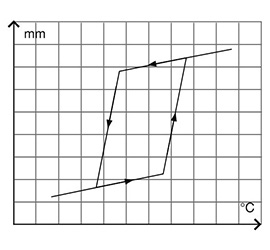
In other words, the mechanism does not react in exactly the same way during temperature increase and temperature decrease.
Difference between actuation temperature and reset temperature
The actuation temperature corresponds to the point at which the mechanism leaves its initial position. The reset temperature corresponds to the point at which it returns to that position.
In a mechanism without hysteresis, these two temperatures would be identical. In practice, this situation is rarely desirable.
Consider an installation whose temperature naturally varies between 79°C and 81°C. If the mechanism opens and closes at exactly 80°C, it may oscillate and switch continuously. Every slight thermal fluctuation would cause another change of state.
This phenomenon may cause:
- Premature mechanical fatigue;
- Reduced service life;
- Vibrations;
- Noise;
- Loss of system stability.
By deliberately creating a difference between the two temperatures, the mechanism becomes much more stable. It remains open until the temperature has decreased sufficiently. This principle is widely used in regulation and thermal-protection systems.
Why does hysteresis stabilize operation?
Hysteresis acts in a similar way to a safety band. It creates an operating range within which the mechanism maintains its current state despite small temperature variations. This is referred to as bistable operation.
This characteristic offers several advantages:
- It enables automatic return to the initial state when human intervention is not required;
- It reduces maintenance interventions;
- It limits unnecessary switching during small temperature variations;
- It reduces mechanical stress;
- It extends component service life;
- It makes operation much more predictable;
- Finally, it helps maintain greater stability in industrial equipment.
This concept is particularly important in installations subjected to continuous thermal variations.
Without hysteresis, some mechanisms would require manual resetting after non-hazardous actuation events.
Without hysteresis, some mechanisms could change state several dozen times within a few minutes. With properly sized hysteresis, these oscillations virtually disappear. System operation becomes more reliable, quieter and more durable.
Applications suited to hysteresis
Hysteresis is used in a wide range of applications where operational stability is essential.
Typical applications include:
- Thermal regulation systems;
- Automatic ventilation devices;
- Heating equipment;
- Overheating protection mechanisms;
- Industrial systems subjected to continuous thermal variations.
In each of these examples, the objective is the same: to ensure automatic return to the initial state and, in some cases, to prevent the mechanism from continuously switching around the same threshold. This simple temperature difference makes it possible to define both switching conditions according to the direction of temperature variation and significantly improves the overall behavior of the installation. It is often a decisive factor in the quality of a temperature-sensitive mechanism design.
Comparison table: hysteresis
| CRITERION | HYSTERESIS |
| Principle | Difference between actuation and reset temperatures |
| Objective | Automate reset or stabilize operation |
| Actuation temperature | Different from the reset temperature |
| Main effect | Fully automatic operation and reduced repetitive switching |
| Preferred applications | Regulation, ventilation, thermal oprotection, heating |
| Main benefit | Improved reliability and service life |
How to choose the right type of motion?
Understanding the different behaviors of a temperature-sensitive mechanism is a first step; determining which one should be selected for an industrial application is another.
In practice, no type of motion is inherently “better” than another. Progressive motion is not superior to snap-action motion, nor does snap-action motion systematically require hysteresis.
Each behavior meets a specific functional need. The designer must therefore identify the actual constraints of the application before selecting the most suitable mechanical behavior.
This approach helps prevent many design errors and ensures that the mechanism performs its intended function reliably over time.
Analyzing the required function
The first question is simple: what exact function must the mechanism perform? This functional analysis determines the direction of the entire project.
A system intended to progressively regulate airflow will not be designed in the same way as a device intended to trigger thermal protection.
The required behavior must therefore be clearly identified from the earliest design phases.
The questions to consider include:
- Must the mechanism regulate or simply switch?
- Is a progressive response preferable to instantaneous action?
- Must the mechanism automatically return to its initial position?
The answers naturally guide the choice toward one of the behaviors described above. This analysis phase is essential. It prevents a technical solution from being sought before the actual requirement has been properly defined.
Defining the required temperature, stroke and force
Mechanical behavior is only one design parameter. The mechanism must also meet precise performance requirements.
The designer must notably define:
- The required type of motion: progressive or snap-action;
- The actuation temperature;
- Any required reset temperature;
- The required displacement amplitude;
- The mechanical force to be transmitted;
- The target number of cycles;
- The expected service life.
These parameters are interdependent. For example, a large stroke may require a specific bimetal geometry. Similarly, high mechanical force may influence material selection or mechanism kinematics.
The objective is to find the best compromise between precision, reliability, available space and performance. This sizing phase is a decisive stage in the success of the project.
Taking the operating environment into account
A temperature-sensitive mechanism is never designed independently of its environment. Operating conditions directly influence its behavior and service life.
Several parameters must be analyzed:
- The actual operating temperature range;
- Expected thermal variations;
- Humidity;
- Vibrations;
- Corrosive atmospheres;
- Dust;
- Mechanical constraints;
- Planned maintenance operations.
A mechanism intended to operate in a climate-controlled laboratory will not be designed in the same way as a device installed on industrial equipment exposed to weather conditions or large temperature variations.
The environment therefore forms an integral part of the design criteria. It influences material selection, mechanism geometry and the required behavior.
Validating behavior through testing
Even when a mechanism has been carefully studied and sized, validation remains essential. Testing confirms that the observed behavior matches the expected performance.
Tests notably cover:
- The actual actuation temperature;
- The reset temperature;
- Cycle repeatability;
- Motion speed;
- Generated mechanical forces;
- Long-term operating stability.
This experimental phase also makes it possible to adjust certain parameters before industrialization. Minor changes to geometry, materials or kinematics may sometimes significantly improve mechanism performance.
Testing therefore represents the final validation stage before the solution is integrated into its final equipment.
Selection guide
| FUNCTIONAL REQUIREMENT | RECOMMENDED MOTION |
| Progressively Regulate a Function | Progressive Motion |
| Obtain Positive Switching | Snap-Action Motion |
| Prevent Automatic Reset: Safety Function | Snap-Action Motion Without Hysteresis |
| Obtain Automatic Reset | Snap-Action Motion With Hysteresis |
| Prevent Repetitive Switching | Snap-Action Motion With Hysteresis |
| Provide Natural Ventilation | Progressive Motion |
| Protect Equipment Against Overheating | Snap-Action Motion With Hysteresis |
| Stabilize a System Subjected to Thermal Fluctuations | Snap-Action Motion With Hysteresis |
How does DELTA CONCEPT help select the appropriate motion?
Selecting the mechanical behavior of a temperature-sensitive mechanism cannot be reduced to a simple technical decision. It results from an overall analysis combining functional objectives, industrial constraints, expected performance and actual operating conditions.
Experience plays a decisive role in this process. Two apparently similar mechanisms may behave very differently depending on their geometry, the materials used or their integration into the final equipment.
This is why DELTA CONCEPT does not rely on standardized solutions, but on a genuine engineering approach aimed at developing the most appropriate mechanical behavior for each application.
Custom functional analysis
Every project begins with a listening and analysis phase. Before studying a bimetal element or defining an actuation temperature, Delta Concept’s teams seek to understand the functional requirements of the application.
This stage involves answering several essential questions:
- What function must the mechanism perform?
- What would be the consequences of actuation occurring too early or too late?
- Does the function require continuous regulation or positive switching?
- Is automatic reset required?
- What are the space, maintenance and service-life constraints?
This analysis guides technical choices from the earliest stages of the project and prevents unsuitable development paths. It is the starting point for a genuinely customized design.
Expertise in thermomechanical behavior
Designing a temperature-sensitive mechanism does not simply require an understanding of material properties. It also requires mastery of the interactions between part geometry, mechanical forces, thermal expansion phenomena and operating conditions. This expertise enables DELTA CONCEPT to develop mechanisms capable of producing very different behaviors from the same physical principle.
Depending on the requirements, its teams can design systems providing:
- Progressive motion for continuous regulation;
- Rapid motion to ensure fast response;
- Snap-action motion when the function requires particularly positive switching;
- Snap-action motion with Hysteresis when automatic reset is required;
- Controlled Hysteresis to improve operating stability.
This ability to precisely adapt mechanism behavior is one of DELTA CONCEPT’s main areas of added value. It makes it possible to address complex industrial challenges while maintaining a simple, robust and durable mechanical architecture.
Design adapted to each application
Every industrial environment has its own constraints. A solution developed for ventilation equipment will not necessarily meet the requirements of a safety system, thermal regulation device or mechanism integrated into a production machine. DELTA CONCEPT therefore favors a fully customized approach.
Each mechanism is designed according to:
- The required function;
- The actuation temperature;
- The required type of motion;
- The necessary mechanical force;
- Environmental constraints;
- The required service life;
- Integration conditions within the final equipment.
This approach provides solutions perfectly adapted to the needs of engineering departments and industrial manufacturers while ensuring high levels of reliability and repeatability. Beyond designing a component, DELTA CONCEPT supports its customers in the development of a complete thermomechanical solution.
FAQ
What are the main types of motion generated by a temperature-sensitive mechanism?
The three main types of behavior are progressive motion, simple snap-action motion, and snap-action motion with hysteresis. Each addresses different industrial requirements and must be selected according to the required function, application constraints and expected performance.
What is the difference between progressive motion and snap-action motion?
Progressive motion continuously follows the change in temperature. It is mainly used for regulation functions.
Snap-action motion, by contrast, remains stable until a precise threshold is reached and then rapidly changes position. This behavior provides particularly positive switching. It is especially suitable for safety, protection or automatic actuation functions.
What is the purpose of hysteresis in a temperature-sensitive mechanism?
Hysteresis makes it possible to create an automatic return to the initial state. A second actuation temperature is then defined, corresponding to the return to the initial position.
Hysteresis specifies the difference between the actuation temperature and the reset temperature. Among other benefits, this characteristic prevents repetitive switching when the temperature oscillates around the same threshold. It therefore improves operating stability, limits mechanical wear and extends mechanism service life.
How should the correct motion be selected for an industrial application?
The choice depends on several criteria: the required function, actuation temperature, expected response speed, mechanical stroke, force to be transmitted, environmental constraints and required service life. Functional analysis performed at the beginning of the project makes it possible to identify the behavior best suited to each application.
Conclusion
The behavior of a temperature-sensitive mechanism is a fundamental aspect of its design. More than material selection or actuation temperature, the way the mechanism reacts to a thermal variation determines its effectiveness in an industrial application.
Progressive motion provides continuous regulation.
Snap-action motion ensures sudden switching. Specifying hysteresis where required provides automatic reset or, at the very least, stabilizes operation by preventing oscillation around a single threshold.
Understanding these different behaviors allows engineers and engineering departments to select the most appropriate solution according to the constraints of their project. This process is not based on a standardized approach, but on a genuine engineering analysis combining functional analysis, sizing, testing and validation.
Thanks to its expertise in thermomechanics, DELTA CONCEPT supports industrial manufacturers in designing custom mechanisms capable of precisely meeting the requirements of each application. Selecting the correct motion is not merely a technical decision: it is an essential means of improving the reliability, durability and overall performance of industrial equipment.