

Fire dampers: the key role of bimetal thermal actuators
In brief!
In passive fire safety systems, fire dampers play a vital role in preventing the spread of flames and smoke through ventilation networks. The activation of these devices often relies on a reliable, autonomous, and power-free technology: bimetal thermal actuators. These components use the differential thermal expansion of two co-laminated metal strips, to deform and activate a mechanical mechanism—without electronics, without maintenance, and with a high level of reliability. This technology is particularly suited to demanding environments where responsiveness and safety cannot depend on external energy sources. It provides an effective, cost-efficient, and standards-compliant solution to the critical fire safety challenges of modern buildings.
Fire safety: a critical challenge in modern buildings
Why stopping smoke propagation is vital
When a fire breaks out, flames are not always the primary cause of human casualties. Instead, it is the rapid spread of hot, toxic, and opaque smoke that poses the greatest danger. Smoke travels quickly through ventilation systems, technical ducts, and suspended ceilings, endangering occupants long before flames reach them. Most fatalities in enclosed environments are caused by carbon monoxide poisoning and dense smoke inhalation. This is why compartmentalization and the rapid shutdown of airflows are essential.
The central role of fire dampers in passive protection
Fire dampers are essential components of passive fire protection. Integrated into ventilation systems, they allow normal HVAC operation under standard conditions, but close immediately when temperature rises, creating a physical barrier against fire and smoke. Their installation is mandatory in many building types under current regulations (public buildings, high-rise buildings, hospitals, etc.). Their effectiveness depends on their ability to remain open during normal operation and to close hermetically and autonomously in the event of a fire.
The bimetal actuator: autonomous triggering technology
The bimetal actuator ensures both thermal detection and mechanical triggering of the fire damper. Unlike electronic detectors or controlled systems, it relies solely on a physical principle: the differential expansion of two co-laminated metals. This guarantees reliable activation without electrical power or regular maintenance. When temperature rises, the controlled deformation of the bimetal triggers the immediate closure of the damper.
Understanding the operation of bimetal fire dampers
Fire damper construction
A standard fire damper includes several essential components:
- The housing: a metal structure, typically galvanized steel, ensuring fire resistance and duct integration
- The blade: a movable shutter designed to withstand high temperatures and provide airtight sealing
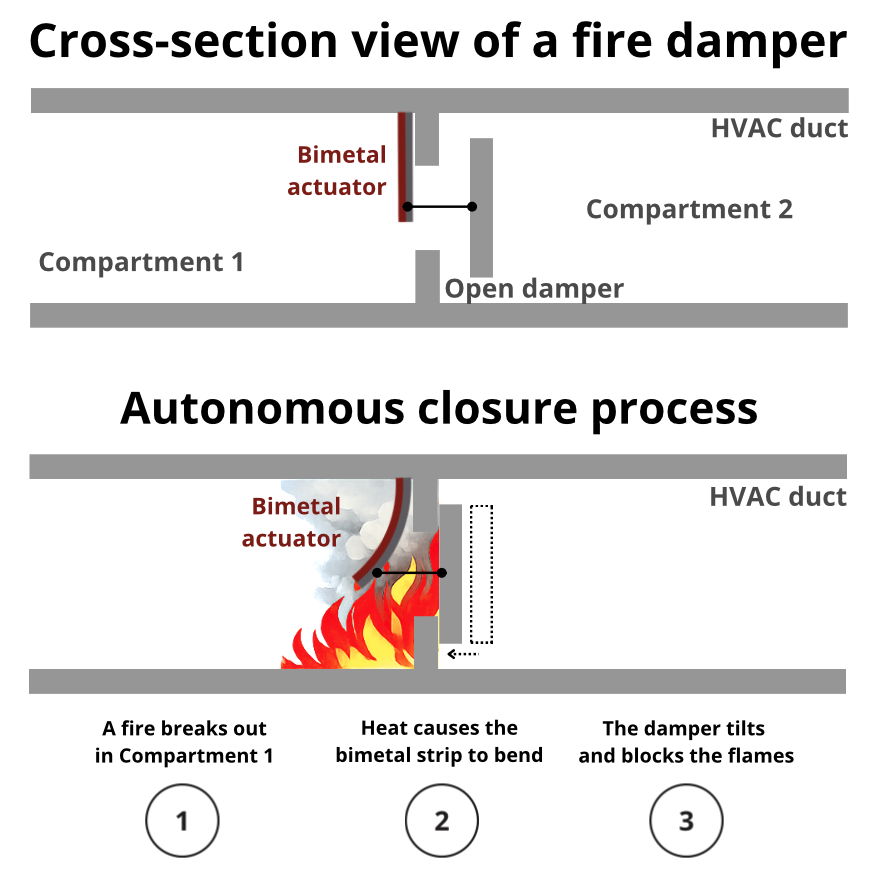
- The spring or closing mechanism: usually compressed by a latch, ensuring rapid closure once triggered
- The bimetal thermal actuator: the triggering element that reacts to ambient temperature.
This simple yet proven assembly enables rapid response to temperature increases.
Bimetal operation under extreme thermal conditions
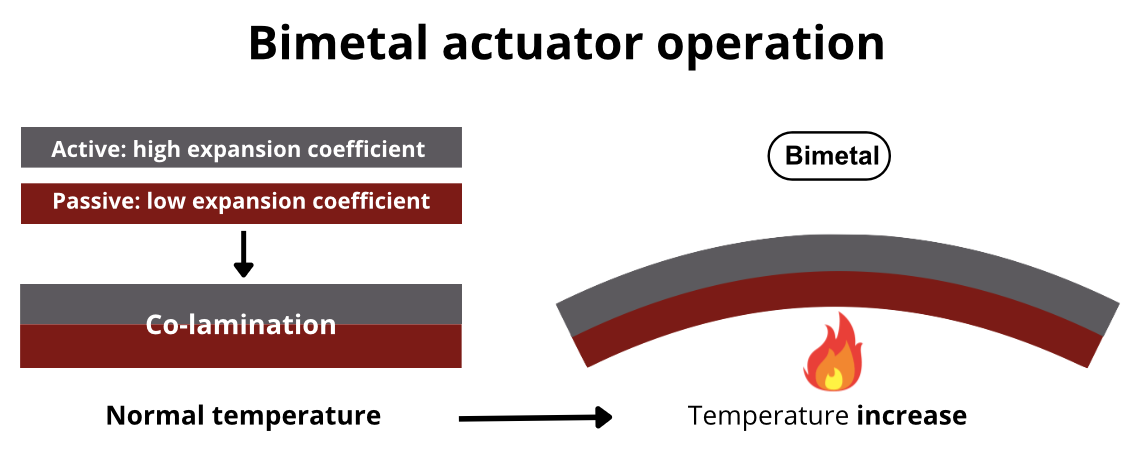
A bimetal consists of two co-laminated metal strips with different thermal expansion coefficients. When exposed to heat, one metal expands more than the other, causing the strip to bend. By shaping the bimetal appropriately, a sudden deformation occurs at a defined temperature. This movement releases a latch or actuates a lever, activating the damper’s closing mechanism. The system is calibrated to react at temperatures defined by fire safety regulations, ensuring reliable triggering during every incident.
Comparison with motorized or fusible triggering devices
Motorized systems require a constant power supply, making them vulnerable in the event of electrical failure. Thermal fuses, on the other hand, are often single-use and less precise in triggering.
By contrast, bimetal actuators are:
- fully autonomous
- resettable and reusable in most cases
- robust and resistant to dust and humidity
- extremely reliable in triggering temperature, regardless of installation age.
Specific advantages of bimetal actuators
Complete autonomy: triggering without power neither control
One of the greatest advantages of this technology is its autonomy. Operation is ensured without any external energy input. Even in the event of power failure, network disruption, or sabotage, the system remains fully operational. This feature meets the most stringent passive fire safety standards.
Reliability and minimal maintenance: long service life
Bimetals are passive mechanical components with no internal moving parts subject to wear, and no electronic components with limited lifespan. Their service life can exceed 40 years, with little to no intervention. They are particularly suited to hard-to-access installations, aggressive environments, or critical systems that tolerate no failure.
Calibrated responsiveness: precise triggering thresholds
Each actuator can be calibrated to react at a specific temperature, typically between 60 °C and 140 °C. This customization allows adaptation to building thermal configurations, duct types, and ventilation constraints. The consistency of deformation and repeatability of performance ensure unmatched triggering precision.
Standards, regulations, and system integration
Applicable European standards (EN 1366, EN 15650, etc.)
Fire damper compliance is governed by strict standards:
- EN 1366-2: fire resistance testing methods for ventilation dampers.
- EN 15650: technical specifications for fire damper closing devices.
- EN 13501-3: fire resistance classification.
Actuators must be certified and integrated into systems tested and validated under these standards. CE marking is mandatory to ensure regulatory compliance.
Compatibility with HVAC architectures
Bimetal actuators integrate easily into all HVAC configurations:
- single- or dual-flow systems
- rigid or flexible duct networks
- mechanical smoke extraction systems
- air handling units with bypass.
Installation recommendations and key precautions
To ensure optimal operation, installers must:
- correctly position the actuator relative to airflow
- avoid embedding it in thermal insulation
- ensure accessibility for regulatory testing
- validate compliance at project completion with hot tests.
Case studies / use cases
Fire dampers in hospitals and public buildings
In hospitals and public buildings, fire safety is non-negotiable. Fire dampers must combine silent operation, total reliability, and regulatory compliance. Bimetal actuators provide a robust, tested solution suited to these sensitive environments while minimizing maintenance requirements
Fire safety in rail transportation
In metro trains, trams, and intercity rail systems, onboard components must meet strict requirements for safety, compactness, and vibration resistance. Bimetal systems are ideally suited: miniaturized, encapsulated, immune to electrical interference, and capable of securing ventilation ducts without energy consumption.
Protection of data centers and sensitive facilities
In IT rooms and critical infrastructures (data centers, control rooms), thermal regulation is essential. Uncontrolled overheating can cause major failures. Bimetal actuators regulate cooling or hot air intake, preventing excessive temperatures. Their reliability ensures maximum service continuity
Selection and customization of bimetal actuators
Trigger temperature and mechanical configuration
Each project has specific requirements. Trigger temperatures can be precisely calibrated (e.g., 72 °C for ventilated ducts, 93 °C for technical areas). Bimetal dimensions, mounting type, and deformation direction are fully customizable.
Integration into certified fire dampers
Fire damper manufacturers work closely with bimetal specialists such as Delta Concept to integrate perfectly adapted actuators. These partnerships ensure regulatory compliance, verified fire resistance, and proven durability under real conditions
Advantages of custom solutions from an expert manufacturer
By choosing a partner like Delta Concept, you benefit from:
- prototypes tailored to your needs
- complete technical documentation (curves, certificates, datasheets)
- project support for integration and validation
- serial production capability aligned with your logistics constraints
Technical FAQ: what integrators ask
- What tolerance applies to triggering temperature?
Standard tolerance is ±3°C, but can be reduced on request depending on application requirements.
- What is the service life in dusty environments?
An encapsulated actuator can achieve 30 to 40 years of service life, even in the presence of fine particles, humidity, or vibration.
- Can bimetal and electrical triggering be combined?
Yes. Hybrid solutions are used in critical installations, allowing either automatic temperature triggering or remote activation via a fire detection control unit.
- What are the conditions for CE compliance?
Products must be tested in accredited laboratories, supported by full test reports, up-to-date technical documentation, and component traceability throughout the production chain.
- Is bimetal compatible with ATEX environments?
Subject to specific design requirements (sealing, absence of ignition sources), bimetal actuators can be used in explosive atmospheres (e.g., ATEX Zone 2).
Infographic
An exclusive infographic « How a bimetal fire damper works in 3 steps » :
Are you a specifier, integrator, or HVAC system manufacturer?
Discover Delta Concept’s technical solutions, including:
- SNAPTEMP Lock : high-precision, certified thermal trigger,
- SNAPTEMP Tracker : robust bimetal actuator for extreme conditions,
- Custom bimetal technology: developed according to your specifications.
Contact our engineers to assess compatibility with your projects!